
You can really predict your experience before you ever walk through the door or place an order by reading business consistency and response patterns.. Read more
You’ve been there. You read a glowing five-star review, trusted it, and showed up only to find something completely different. The food was cold, the contractor never called back, the stylist who supposedly transformed someone’s hair was booked out for three months and her replacement had no idea what she was doing. The review wasn’t wrong — it just wasn’t enough.
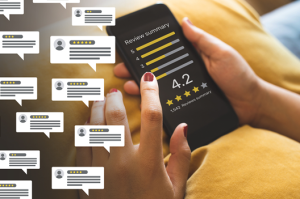
The problem with most review reading is that consumers are trained to focus on the wrong thing. They count stars. They look for the most recent review. They check whether the overall rating is above four. But none of those signals reliably tells you what YOUR experience will be like, because they collapse everything into a single number that obscures the two things that matter most: does this business perform the same way month after month, and does it show up for customers when something inevitably goes sideways?
According to the BrightLocal Local Consumer Review Survey 2025, just 7% of consumers say they don’t expect businesses to respond to their reviews — which means the overwhelming majority of people already sense, at some level, that responsiveness matters. But most of us don’t know exactly what to look for, or how to read it systematically before making a purchasing decision. That’s what this post is about. By the end, you’ll have a concrete method for reading any business’s review history in about five minutes and walking away with a confident, evidence-based prediction about what you’re going to experience.
Can I really predict what my experience will be like before I ever walk through the door or place an order? Yes — and the two strongest signals are consistency and responsiveness. Consistency tells you whether a business delivers reliably across time, not just on its best day. Responsiveness tells you what happens when something goes wrong. Together, they give you a far more accurate picture of what you’re actually buying than any single star rating ever could. |
A single review — even an enthusiastic, detailed, well-written one — is a snapshot. It tells you what one person experienced on one day with one staff member under conditions you can’t fully verify. It doesn’t tell you whether that experience was typical or exceptional. It doesn’t tell you whether quality has held steady since that review was written, whether staff turnover reshuffled everything, or whether the original owner sold the business two years ago. It’s a data point without context, and context is everything.
Think about how you’d evaluate a restaurant if a friend described one meal they had there five years ago. You’d probably ask follow-up questions. Did they go back? Was it still good? Does anyone else they know go there? What you’re really doing is trying to build a picture of consistency. You instinctively know that one data point is fragile.
The same principle applies to review platforms — and yet most people don’t read reviews the way they’d listen to a friend’s recommendation. They skim the most recent five-star, feel reassured, and move on. Meanwhile, the actual story of the business is embedded in the full review timeline, in the patterns across hundreds of reviews, and in the way the owner has responded to the difficult ones. That story is available to you. You just have to know how to read it.
Consistency, in the context of reviews, means the same quality being delivered repeatedly across different customers, different days, and different seasons. You can see this — or its absence — when you take a few minutes to read reviews chronologically rather than simply reading the top handful.
A consistent business has a review history that looks relatively flat and positive over time. Not every review is five stars, and that’s fine — that’s realistic. What you’re looking for is a steady baseline. Reviews from two years ago say roughly the same things as reviews from last month. Complaints, when they appear, are scattered and situational rather than clustered. The things people praise stay the same over time: the friendliness of the staff, the quality of the ingredients, the punctuality of the service, the precision of the work. When those same compliments keep appearing from different people across different months, you have genuine evidence of consistency.
You also want to look at the volume and spacing of reviews over time. A business that has collected reviews steadily for years is showing you that it has served a sustained stream of customers who cared enough to say something. That’s different from a business with 60 reviews that all arrived within the same two-month window and then went quiet. Organic, distributed review volume is itself a consistency signal.
Pay attention to the recurring details. If reviewer after reviewer mentions the same employee by name, the same specialty item, the same aspect of the experience, that tells you something valuable is reliably available. If you’re specifically choosing a business for that reason, those recurring details are your strongest confirmation that it will be there when you show up.
Owner responses to reviews are one of the most underread signals available to consumers. Most people scroll past them entirely. That’s a mistake, because how a business responds to its reviews — both positive and negative — tells you more about its character than almost anything else in the review section.
Start with the negative reviews, because that’s where their character really shows. When a customer leaves a critical or frustrated review, the owner has a choice: respond defensively and protect their ego, ignore it entirely, or respond with genuine engagement and a real attempt to understand and resolve the issue. A business that consistently chooses the third path is showing you something important about how it treats the people who pay its bills.
Look for warmth, specificity, and resolution. A good owner’s response acknowledges the specific complaint rather than offering a generic apology. It takes responsibility where responsibility is warranted. It invites the customer to continue the conversation — a phone number, an email address, a genuine offer to make things right. And ideally, when you scroll forward in time, you can see whether that follow-up actually happened or whether the public gesture was the end of it.
Responsiveness also shows up in positive review replies. Does the owner actually thank specific people and mention specific details from their reviews, or do they copy and paste the same “Thanks for visiting us!” across hundreds of responses? The businesses that write real, personal replies to positive reviews are the same ones that will write real, personal replies when you have a problem. They’re engaged. They see customers as people, not transactions.
Once you know what to look for, certain patterns become impossible to ignore — and they’re your clearest warnings to look elsewhere.
The first red flag is a cluster of complaints about the same issue appearing within a short time window. If you filter to one-star and two-star reviews and notice that five or six people all mentioned the same problem in the same three-month period, something changed. Maybe a key employee left. Maybe ownership transferred. Maybe costs were cut and quality followed. Whatever the cause, a cluster of similar complaints in a compressed timeframe is a signal that the business is in a period of inconsistency — and that the probability of you having a similar experience is meaningfully higher than it would be at other times.
The second red flag is a sudden and unexplained drop in average rating. A business that held a 4.7 for three years and is now sitting at 3.9 has experienced something. That decline didn’t happen by accident, and unless there’s a clear explanation visible in the owner’s responses, you have no way of knowing whether the issue has been resolved.
The third red flag is defensive or dismissive owner responses. When a business owner replies to a one-star review by arguing with the customer, questioning their memory, or implying they’re lying, that tells you how this business handles conflict. That behavior doesn’t stay in the review section — it follows you into your own experience the moment something goes wrong.
The fourth red flag is silence. A business that never responds to reviews — positive or negative — across hundreds of interactions is a business that doesn’t see engagement with customers as worth its time. That indifference tends to show up everywhere eventually.
The inverse of every red flag is a green one, and knowing what a healthy review profile looks like makes it easy to feel genuinely confident before you commit.
Steady reviews over a long period of time, with a consistent average rating, are your strongest green flag. They tell you that many different customers across many different circumstances have had experiences that were good enough to document. That’s not luck. That’s a business that has built reliable systems, developed a consistent team, and maintained quality as a habit rather than a performance.
Warm, specific, and human owner responses to criticism are the second green flag. When you read a reply that mentions the customer’s name, acknowledges a specific detail of their complaint, offers a direct way to continue the conversation, and doesn’t get defensive — you’re reading a business that knows how to handle adversity. That’s the business you want when your order gets messed up or the job doesn’t go as planned, because it will handle your problem the same way it handled everyone else’s.
A third green flag is improvement over time. If you see a cluster of complaints from two years ago followed by owner responses that clearly acknowledge a systemic issue, and then you notice the complaints stop appearing — that’s a business that listened, adapted, and got better. That kind of track record is actually more reassuring than a business that has never had a single complaint, because it shows you exactly how they respond to pressure.
Finally, look for organic detail in positive reviews. When customers spontaneously mention the same specific things — a staff member’s name, a particular product, a recurring aspect of the experience — without being prompted, you’re reading a business that is consistently creating something memorable. That’s the kind of consistency that follows you home.
You don’t need to spend an hour analyzing a business’s review history. A structured five-minute scan gives you most of what you need to make a confident decision.
Start by sorting reviews by date and scrolling through the last 12 months. Look at the distribution — does the rating stay relatively stable, or does it move around significantly? Note any clusters of complaints and read those specifically to understand what happened.
Then filter to one and two-star reviews and read ten of them. Don’t read them to find horror stories. Read them to understand the types of problems this business creates, how often they appear, and whether they point to a systemic issue or scattered individual circumstances. Most businesses have some negative reviews. The question is whether the negatives reveal a pattern.
Next, read ten owner responses to negative reviews. Forget what the customer said — focus entirely on how the owner replied. Ask yourself whether you would feel respected and helped if you received that response after a bad experience. If the answer is yes, that’s a strong signal. If the answer is no, trust it.
Finally, scan the positive reviews for recurring themes. What do people consistently love? Is that the specific thing you’re going there for? If the same quality you need keeps appearing across different reviewers over different months, you have solid evidence that you’ll find it too.
That four-step process takes about five minutes and gives you more predictive power than any star rating algorithm.
Most review platforms optimize for volume. The businesses with the most reviews surface first, regardless of whether those reviews paint a consistent picture or whether the owner is engaged with their customers in any meaningful way. That creates a system where a business that collected 500 reviews three years ago and has since gone quiet ranks above a business that has quietly served its community with excellence and earned 80 steady, recent, deeply positive reviews.
Trusti is built around a different set of values. The TRUST Pillars — Proximity, Reciprocity, Verification, Consistency, Impact, Transparency, and Responsiveness — are not marketing language. They’re the actual framework Trusti uses to surface businesses. Consistency and Responsiveness are two of those pillars, and they’re weighted into how businesses appear on the platform.
When you search for a local business on Trusti, you’re seeing businesses that have demonstrated both qualities, not just businesses that have accumulated the most reviews. Trusti looks at review patterns over time, not just aggregate scores. It considers how businesses engage with their customers, not just what rating those customers left. And because Trusti verifies businesses against local community standards, you’re not sorting through a mix of legitimate and unverifiable listings hoping to find something trustworthy.
The result is that the five-minute scan described above becomes even faster on Trusti, because the businesses that surface strongest are already the ones that have shown consistency and responsiveness across their review histories. You can still do your own reading — and you should — but you’re starting from a much more curated and reliable baseline.
There’s no single magic number, but a useful threshold is somewhere around 30 to 50 reviews spread over at least 12 months. Below that, you don’t have enough data points to distinguish a consistent pattern from random variation. A business with 25 reviews collected in a single month is harder to read than a business with 40 reviews collected steadily over two years. What you’re really evaluating is the combination of volume and distribution over time, not a raw count. The BrightLocal 2025 data shows a growing percentage of consumers are willing to make decisions on businesses with as few as 0–49 reviews, which is a reminder that pattern-reading matters more than hitting an arbitrary number.
Not automatically, but it is a yellow flag worth noting. A business that doesn’t respond to reviews isn’t necessarily a bad business — some very good small operations simply don’t have the bandwidth or digital literacy to manage their online presence consistently. However, silence does tell you something about what to expect if you have a problem and need to reach someone. Cross-reference the lack of responses against the quality and consistency of the reviews themselves. If the reviews are strong, numerous, and steady, you can have reasonable confidence even without owner engagement. If the reviews are mixed and the owner is silent, you have less to work with and should factor in some additional caution.
Look at both the timing and the owner responses. A rough patch typically has a defined window — a cluster of issues concentrated in a short period — followed by a recovery visible in later reviews. Often the owner will acknowledge the problem explicitly in their responses, which is actually a good sign because it means they were paying attention. Genuine decline looks different: a slow, sustained drift in quality that keeps appearing in reviews without resolution, with no visible acknowledgment from ownership, and no visible improvement over a year or more. If the trajectory is downward and continuous, treat it as structural rather than situational.
Yes and no. Older reviews are valuable for establishing the long-term baseline — they tell you what this business has been capable of. But they shouldn’t override recent signals. A business that was excellent three years ago and has a string of recent complaints deserves the same scrutiny as any other business with a mixed recent record. The most useful way to read older reviews is as context for recent ones. They tell you whether current performance represents who this business normally is, or whether something has changed.
The main difference is curation and values alignment. Google and Yelp optimize largely for volume and recency, which means businesses that are good at generating review volume surface above businesses that may actually be more consistent and more responsive. Trusti is built around verified, locally-rooted businesses that are evaluated against the TRUST Pillars — including Consistency and Responsiveness specifically. That means the businesses you encounter on Trusti have already been filtered through a framework designed to surface the qualities that predict a good experience, not just the qualities that produce a high aggregate rating. You’re still encouraged to read the reviews and draw your own conclusions, but you’re starting from a more trustworthy pool.
You now have a framework for reading any business’s review history and predicting what your experience will look like before you spend a dollar or book an appointment. Consistency tells you whether a business delivers reliably. Responsiveness tells you whether it shows up for you when things go wrong. Together, they’re the most honest predictors available to any consumer.
Start browsing local businesses and their offers at trusti.com.
Read related Trusti stories, tips, and insights to help you make better community-based decisions.

Get the latest strategies, tips, and expert advice delivered directly to your inbox.
By signing up, you agree to our Terms and Conditions.
Join your community and help make the world a more trusted place—one review at a time.

Trusti Chief Marketing Officer
Bill Merrow is the Chief Marketing Officer at Trusti, where he writes about how local businesses grow through trusted community recommendations instead of anonymous reviews and paid ads.
A fractional CMO for more than 100 firms worldwide, Bill has led marketing and sales transformations at Cigna Healthcare, American Express, and General Electric — including building a 40,000+ person sales force and an annuity launch that drove $500 million in sales in 18 months.
His work centers on community-led growth, answer engine and SEO visibility, direct-response copywriting, and the referral, recognition, and lifecycle systems that turn happy customers into a business’s most effective sales force.
Bill believes the shortest path to a new customer is still a neighbor’s recommendation — and that marketing’s job is to make that endorsement easier to earn, easier to share, and impossible to ignore.


© 2026 Trusti | All rights reserved