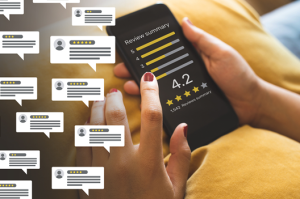


A complete Trusti profile unlocks better local business recommendations, more trusted reviews, and smarter community matches. Read more
Think about the last time you asked a stranger for a restaurant recommendation versus asking a neighbor who knows your neighborhood, your food preferences, and whether you have kids in tow. The stranger might give you a perfectly fine answer. The neighbor gives you the right answer. That gap — between generic and genuinely useful — is exactly what separates a blank Trusti profile from a complete one.
According to the BrightLocal Local Consumer Review Survey 2024, 48% of consumers feel more positive about a business when reviews are written by named, identified users rather than anonymous accounts — up from just 40% the year before. Identity signals trust. And trust is what makes local discovery actually work.
Trusti was built on the premise that local business decisions — finding a pediatrician, hiring a plumber, switching to a new hair salon after a move — deserve more than a star rating left by a username that could be anyone. The platform is designed to put community context around those decisions. But community context only works when you participate in it. Your profile is where that participation begins.
Why does completing your Trusti profile actually matter for finding local businesses?
Your Trusti profile is the input signal the platform uses to determine what it shows you. A complete profile — including your neighborhood, interests, and community memberships — allows Trusti to surface more relevant local business recommendations, match your reviews to real credibility, and connect you with the geographic and interest-based communities where the businesses you actually need are most active. Skipping the profile setup doesn’t protect your privacy; it just degrades the quality of everything you see.
Every platform that tries to surface relevant content — whether it’s a streaming service, a news app, or a local business marketplace — relies on signals to understand who you are and what you actually want. Trusti is no different, except the stakes are higher. When Netflix recommends a movie you don’t enjoy, you watch something else. When a local business platform fails to recommend the right dentist or the right mechanic, you waste time, money, and sometimes a great deal of stress on a bad experience.
Your Trusti profile is the primary signal the platform uses to personalize everything you see. When you tell Trusti where you live — your specific neighborhood, not just your city — the platform can prioritize businesses within a radius that is actually convenient for you. When you note the categories of services you use most frequently, Trusti can weight those business types more heavily in your discovery feed. When you join community groups that align with your life — a neighborhood association, a parenting group, a homeowner community — you gain access to the recommendations and reviews from people who share your specific context.
Without a complete profile, Trusti has to make generic assumptions. It might show you businesses that are technically in your metro area but a forty-minute drive away. It might surface reviews from members whose neighborhoods, family situations, and service priorities are entirely different from yours. The platform isn’t broken in those cases — it simply does not have the inputs it needs to do better. Completing your profile gives it those inputs.
This is not about the platform collecting data for its own sake. It is about you getting what you came for: the local business that actually fits your life, recommended by people who actually share your context.
A complete Trusti profile is not a complicated undertaking. It is not asking you to fill out a questionnaire or write a biography. What it does ask for is the specific information that makes local recommendations genuinely local and genuinely personal.
Your location details matter most. This means more than your city — it means your neighborhood or zip code, which tells Trusti the difference between a restaurant that is three blocks from your front door and one that requires a twenty-minute drive. For someone without a car, or with young children, or who values walkability, that distinction is everything. For someone who commutes across town, a different geographic preference might apply — and Trusti can account for that too, once you tell it.
Your service interests shape the businesses Trusti surfaces. If you are a homeowner, noting that you regularly use contractors, landscapers, and HVAC technicians means those business categories appear more prominently in your discovery experience. If you are a new parent, services related to pediatrics, childcare, and family dining become more relevant. These are not exotic preferences — they are simply the facts of your life that transform a general marketplace into one that feels curated specifically for you.
Your community memberships connect you to the social proof that Trusti is specifically designed to amplify. When you join the geographic or interest-based communities relevant to your life, your review feed begins to reflect people whose opinions carry actual weight for your decisions. Their experiences with a plumber, a salon, or a restaurant are more likely to mirror what your own experience would be, because they come from people living within the same context you do.
Finally, your profile photograph and verified identity layer matter more than they might initially seem. We will cover why in the next section — because they directly affect how much weight your own reviews carry with other consumers.
When you leave a review on Trusti, you are not just recording your own experience. You are participating in a community information system that other consumers rely on to make real decisions. The weight those consumers give your review depends significantly on how much they know about who you are.
An anonymous review — one with no profile photo, no location, no community membership, no history of prior reviews — carries the least possible credibility. Other consumers cannot evaluate whether the reviewer’s context is similar to theirs. They cannot tell whether the reviewer is a regular community participant or someone who created an account purely to post one opinion. The review exists, but it lacks the identity signals that make it trustworthy.
A review from a complete-profile Trusti member is a different thing entirely. Your neighborhood is visible. Your community memberships show that you are an active participant in the local ecosystem. Your review history demonstrates a pattern of engagement that no one-off account can replicate. When another consumer — say, someone who just moved into a neighborhood near yours — reads your review of the local pediatric practice, they can see that you are a local parent, an active community member, and someone who has reviewed similar services before. That context transforms your review from a data point into a recommendation from someone credible.
This is reciprocal. As your profile becomes more complete and your review history grows, your contributions gain more visibility within Trusti’s community weighting. Businesses pay attention to reviews from established, completed-profile members. Other consumers search out the perspective of people who share their geography and situation. You become a trusted voice — not because you shouted louder, but because you showed up fully as who you are.
The irony of skipping your profile to “save time” is that it also makes every review you leave less influential. You put in the effort to write thoughtful reviews, and then a thin profile strips much of that effort’s impact away.
Discovery on Trusti is not just about what you search for — it is about what the platform surfaces before you even think to ask. A complete profile makes that ambient discovery dramatically better.
When Trusti knows your neighborhood and your service categories, it can prioritize businesses that are highly rated within your specific geographic cluster. A plumber who is well-reviewed in your neighborhood is more meaningful than a plumber who is well-reviewed across the metro but who has never worked a job near you. Your profile is what tells Trusti which cluster to prioritize.
When Trusti knows your community memberships, it can surface businesses that your fellow community members use and recommend. This is the digital equivalent of a neighborhood Facebook group where someone asks “Does anyone know a good electrician?” — except instead of waiting for replies, Trusti has already aggregated years of community-sourced recommendations and can show them to you instantly. The quality of that aggregation improves as your community affiliations become more specific and complete.
When Trusti knows your review history and service interests, it can also identify gaps — businesses in categories you clearly use frequently but have not yet discovered on the platform. If you review restaurants often but have never interacted with any local mechanics, Trusti can gently surface the well-regarded mechanics in your community before you are in the stressful position of needing one urgently.
This kind of proactive, community-informed discovery is precisely what separates Trusti from a simple search engine or a generic review aggregator. It does not wait for you to know what to look for. It learns your life — at the level of detail you provide — and brings the right businesses to you.
Consider someone who has just moved to a new city. They know no one in their neighborhood, they have no existing relationships with local service providers, and they need to rebuild their entire roster of go-to businesses — doctor, dentist, mechanic, electrician, babysitter, dry cleaner — essentially from scratch. This is one of the most stressful and time-consuming aspects of relocating, and it is exactly the situation where Trusti is designed to be most valuable.
For this new resident, a complete Trusti profile is not a nice-to-have feature. It is the foundation of the entire platform experience. By entering their new neighborhood, joining their local geographic community, and noting the service categories they need most urgently, they immediately gain access to the accumulated recommendations of their new neighbors. Instead of spending weeks asking coworkers for referrals or relying on generic national review platforms that know nothing about their specific street, they can see what the people who actually live near them think of the pediatrician down the road or the HVAC company that services homes like theirs.
Now consider a parent who is looking specifically for a pediatrician. Without a complete profile, Trusti will show them a broad list of healthcare providers in their metro area. With a complete profile — neighborhood specified, parenting community joined, healthcare listed as a priority category — Trusti can surface the providers who are most recommended by parents in their immediate geographic area, filter by practices that are accepting new patients, and weight the reviews by members whose profiles most closely match their own situation. The difference between those two experiences is not minor. One produces a list. The other produces a recommendation you can actually act on.
Or take the case of a small-business owner who is also a Trusti consumer. They understand firsthand what it means to be a local business seeking community trust. They know that their own profile completeness signals to other community members — including other small-business owners — that they are a serious, invested participant in the local economy. When they review a supplier, a commercial landlord, a business service provider, or even a restaurant where they take clients, that review carries the weight of someone who is visibly part of the community fabric. Their complete profile does double duty: it improves their own discovery experience and amplifies the credibility of their contributions to everyone else’s.
The actual time required to complete your Trusti profile is modest. Enter your neighborhood. Select your primary service categories. Join two or three community groups that reflect where you live and what you care about. Add a profile photo. The platform guides you through it step by step, and it rarely takes more than five minutes from start to finish.
What those five minutes unlock is not a one-time benefit. It is a compounding one. Every review you leave from that point forward carries more credibility because it comes from a named, verified, community-integrated profile. Every recommendation you receive is more relevant because the platform understands your geography, your interests, and your community context. Every business you discover through Trusti was filtered through the preferences and affiliations you established when you set up your profile.
Think about how many local business decisions you make in the course of a year. A new doctor visit after a change in insurance. A home repair triggered by something breaking unexpectedly. A recommendation for a birthday dinner. A search for a trustworthy mechanic after moving across town. A childcare option when your usual arrangement falls through. These are not infrequent edge cases — they are the texture of everyday life. And every single one of them goes better when the platform helping you find the right business actually knows who you are.
There is also something worth naming about the reciprocal nature of this exchange. When you use Trusti, you are implicitly asking local businesses to be transparent, verified, and community-accountable. A complete profile is how you extend that same standard to yourself. You are not an anonymous consumer demanding accountability from others while remaining invisible. You are a named, visible member of your local community, participating in a trust ecosystem that works because everyone shows up fully.
Five minutes of setup. Five years of better local discovery. That ratio is not an exaggeration — it is what the platform was designed to deliver, and your complete profile is what makes it possible.
Your profile information on Trusti is used to improve your discovery experience and to add credibility context to your reviews within the community — it is not sold to businesses or used for advertising targeting in the way that large social platforms use personal data. When other community members view your reviews, they can see your location and community memberships as context for your contributions, which is how the platform builds reciprocal trust. For precise details on what is visible to whom, Trusti’s privacy settings let you control the specific elements of your profile that are public within the community.
Updating your profile when you move is actually one of the highest-value things you can do on Trusti, and it takes only a few minutes. Changing your neighborhood and joining your new geographic community immediately reorients all of your discovery experience to your new location. Any reviews you have already left remain part of your history and continue to carry your credibility, while your new location preferences ensure that everything Trusti surfaces going forward is relevant to where you actually live now. Many members find that updating their Trusti profile is one of the first practical steps they take when settling into a new neighborhood.
You can browse the platform with an incomplete profile, but you are essentially using a map without a location pin — the map works, but it cannot tell you how to get from where you are. Incomplete profiles receive generic recommendations that are not filtered by your neighborhood or interests, your reviews carry less weight with other community members because they lack the identity context that builds trust, and community discovery is limited because Trusti cannot suggest the groups most relevant to your specific life. Completing your profile is not a requirement, but it is what transforms Trusti from a passive directory into an active local discovery tool.
The most impactful fields to complete are your neighborhood or zip code and your primary service categories, because these two inputs drive the majority of Trusti’s relevance improvements. Even without a profile photo or extensive community memberships, specifying your location and the types of services you care about most will meaningfully improve the quality of recommendations you receive. From there, you can add community memberships and additional details at whatever pace feels comfortable. Your profile can grow gradually as your confidence in the platform grows — the important thing is to start with the location and category basics rather than leaving both blank.
Businesses on Trusti can see the profile context attached to the reviews they receive, which means a review from a complete-profile member carries a different kind of weight than a review from an anonymous account. A business owner who sees a review from someone in their specific neighborhood, with a history of reviewing similar services, takes that feedback more seriously — both when it is positive and when it identifies a problem. This creates a practical incentive for businesses to respond to your reviews, engage with your feedback, and treat your community participation as meaningful. Your complete profile does not just improve what you see — it changes how the businesses you review see you.
Your local community has been building something on Trusti that you can access right now: years of neighbor-to-neighbor recommendations, verified business profiles, and community-sourced trust signals that no generic search engine can replicate. The only thing standing between you and that accumulated wisdom is five minutes and a complete profile.
Start browsing local businesses and their offers at trusti.com.
Read related Trusti stories, tips, and insights to help you make better community-based decisions.

Get the latest strategies, tips, and expert advice delivered directly to your inbox.
By signing up, you agree to our Terms and Conditions.
Join your community and help make the world a more trusted place—one review at a time.


© 2026 Trusti | All rights reserved