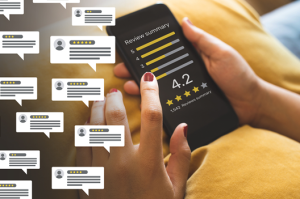


If you’ve tried to find a reliable local business lately using nothing but a search bar, you already know the experience: a long flat list of names, star averages from people you’ve never heard of, reviews that could be from anywhere in the country posted at any time over the past decade. It feels like information, but it’s mostly noise.
According to the Pew Research Center’s Local News Fact Sheet, roughly 72% of Americans say they often or sometimes get local information from other people in their community — friends, neighbors, and family — which means most of us already know, instinctively, that a neighbor’s recommendation beats a five-star average from a stranger. The problem is that until now, there hasn’t been a good way to make that kind of trust scale digitally. That’s exactly what Trusti is built to do.
Discovery on Trusti works because it’s designed around communities first and search results second. When you participate in a community — whether it’s tied to your neighborhood, your school district, your profession, or a hobby — you’re not just browsing; you’re building a context that the platform uses to show you businesses that matter to people who share your situation. This post walks you through how to pick the right communities to join, what active participation looks like, how to read community activity as a genuine trust signal, and why your discovery gets sharper every time you contribute.
Direct answer
Join the communities where people like you already recommend them. On Trusti, you find trusted businesses by participating in groups tied to your geography and interests, where businesses that have earned real engagement rise into view. The more you participate, the more precisely the community reflects what matters to you.
Source: Pew Research Center — Local News Fact Sheet (about 72% of Americans often or sometimes get local information from other people in their community).
How do I find trusted local businesses on Trusti that are actually relevant to my neighborhood and situation? On Trusti, you find trusted businesses by joining the communities where people like you — your neighbors, fellow parents, local hobbyists — are already recommending them. Instead of running a generic search and getting a flat list, you participate in the groups tied to your geography and interests, and the businesses that have earned real engagement there rise naturally into view. The more you participate — reading reviews, leaving your own, following businesses you trust — the more precisely the community reflects what matters to you.
The modern search bar was designed for broadcast-shaped discovery. It takes your query, runs it against an enormous index, and returns a ranked list based on signals like website authority, keyword density, and paid placement — none of which have anything to do with whether a business is right for your specific situation. A pediatric dental practice in your school district with fifty glowing reviews from fellow parents in your neighborhood should surface differently for you than it does for someone searching from across the country. But under a broadcast model, it doesn’t. It gets the same ranking treatment regardless of your context.
The deeper problem is that local decisions are inherently contextual. When you’re choosing a roofer after buying a house in a specific neighborhood, what you actually want to know is whether anyone on your street, or two streets over, has used this contractor and been happy. When you’re looking for a physical therapist because you run ultramarathons, you want to know whether the practice actually understands endurance athletes or whether they’ll just treat you like a generic knee case. A search bar cannot give you that. It can return a name and a phone number. It cannot tell you who in your world trusts this business, under what circumstances, and why.
This is the gap that Trusti’s community-shaped discovery is designed to fill.
Community-shaped discovery starts with people rather than keywords. On Trusti, businesses become visible to you not because they’ve optimized a web page but because real people in your communities have recommended them, followed them, reviewed them, and engaged with them. The activity is local, it’s recent, and it comes from people who share your geography or your interests — which means it actually tells you something.
Think about what it means when a business is showing genuine activity in a Trusti community you belong to. Someone in your neighborhood left a review last month. Several parents in your school district community are following the practice. A fellow hobbyist posted a question, and the business owner responded. That pattern of engagement is a fundamentally different signal than a four-star average accumulated over several years from unidentified reviewers spread across a metropolitan area. The community activity tells you who trusts this business, how recently, and in what context.
You already got a sense of how Trusti builds the foundation for this kind of trust over the first few days of this series — completing your profile so the platform knows your context, writing reviews that contribute real signal to your communities, following businesses you trust so others can see your endorsement, and making referrals when a business earns it. All of those actions feed into the discovery layer. The community you’ve been building is also the lens through which you discover what’s next.
The most useful communities on Trusti are the ones that reflect where you actually live, what you’re actually doing, and what life stage you’re actually in. The platform lets you join multiple communities, and the combination you choose shapes everything that surfaces for you.
Start with geography. Your ZIP code community and your neighborhood community are the foundation. These are the people who have the most direct experience with the businesses you’re likely to need — the ones who hired the plumber on your block, got their car fixed at the shop two miles away, or found a great family doctor on the same side of town. If you haven’t joined your neighborhood community yet, that’s the single most impactful first step.
From there, layer in life-stage communities. If you have school-age children, your school district community will surface an entirely different and more relevant set of businesses than a general city-wide search — pediatricians, tutors, family restaurants, orthodontists, kids’ activity providers, and more, all vetted by parents who are navigating the same logistics you are. If you’re a homeowner who recently moved, joining a first-time homebuyer or home maintenance community will connect you with people who have already gone through the same list of contractors, inspectors, and service providers you’re about to need.
Then add interest and professional communities. If you’re a runner, cyclist, crossfit athlete, or yoga practitioner, joining a fitness community surfaces businesses — physical therapists, sports nutrition shops, coaching services — that have been vetted by people who actually understand what you’re training for. If you’re a freelancer or small business owner, a professional community gives you referrals for accountants, lawyers, and business services from people who have used them in the same context you will.
The goal isn’t to join every community available. It’s to join the handful that most accurately reflect your actual life — your address, your family situation, your work, your interests — and then let those communities do the work of surfacing businesses that are relevant to all of those things at once.
Joining communities is the starting point, but participation is what makes discovery genuinely useful. When you read reviews in your communities, you’re calibrating your sense of which businesses are worth attention. When you leave your own reviews, you’re contributing signal that helps other community members — and that reciprocity is the mechanism that makes Trusti work. The platform is built on a simple premise: the more people contribute honest, contextual information, the better the discovery becomes for everyone.
Active participation doesn’t require a lot of effort or time. It looks like reading the recent activity in your neighborhood community when you’re trying to decide on a service provider and paying attention not just to the star rating but to the specific details people mention. It looks like asking a question in a community when you need a recommendation for something specific — a contractor for a particular kind of job, a specialist with experience in a particular condition — and reading the responses from people who have direct experience. It looks like following businesses that have served you well, so that your endorsement becomes part of the signal that helps the next person in your community find them.
What you’re doing when you participate actively is teaching the platform more about your context. You’re not filling out forms or answering surveys. You’re just engaging with real information about real businesses in communities where that information is relevant. Over time, the combination of communities you belong to, businesses you follow, and reviews you’ve contributed creates a discovery experience that is genuinely tuned to your life rather than to an algorithm optimized for the broadest possible audience.
It’s also worth noting that Trusti is built as a free, frictionless environment. There’s no paywall between you and the community, no premium tier required to see full reviews, no points system that gates participation behind purchases. The design choice is deliberate: community trust only compounds when everyone can participate on equal footing. You shouldn’t have to pay to know whether a business in your neighborhood is worth calling.
Not all activity in a Trusti community carries the same weight, and learning to read it well is part of what makes community-shaped discovery so much more useful than a static star rating.
Recency matters. A business with a steady stream of reviews and follows over the past six months is telling you something meaningfully different from a business with a big star average and reviews that trail off three years ago. Businesses change — ownership changes, quality changes, staff changes — and recent community activity reflects the current reality rather than a historical impression.
Geographic specificity matters too. A roofer who has completed multiple jobs for homeowners in the same ZIP code as yours, and who has earned recent follows and reviews from people in that specific area, is a much stronger signal than one with the same star average earned across a wide metropolitan region. Your neighbors have different houses, different weather exposure, different soil conditions than people on the other side of the metro. Their experience with a contractor is more predictive of your experience than an aggregate score from a much wider pool.
The nature of the engagement matters. A business that a Trusti community member has followed — not just reviewed once, but actively tracked over time — is a business that someone trusts enough to want an ongoing relationship with. A business that has prompted multiple questions and discussions within a community is one that’s genuinely on people’s minds. These are qualitative signals that a star rating simply can’t capture, and they’re visible on Trusti because the platform is built to surface them.
When you see a business with recent, specific, geographically relevant activity from people in your communities, you’re looking at a real trust signal — earned in the place where it matters, from people whose experience is actually relevant to yours.
Consider a young family that has just moved to a new school district. They need a pediatric dentist, and they need one their kids will actually tolerate. A generic web search returns a list of practices across the region, sorted by SEO and ad spend. Trusti’s community discovery surfaces something far more useful: the pediatric dental practices that parents in their specific school district community have been following, reviewing, and recommending to each other — practices where someone who sits on the same parent council, or whose kid is in the same classroom, has recently left a detailed, positive review. That’s not just a name and a phone number. That’s a practice that has earned trust from people who share their exact situation.
Or think about a homebuyer closing on their first house in an established neighborhood. Within weeks, they’re going to need a roofer, an HVAC technician, a plumber, and probably an electrician. A search bar gives them a list of contractors with regional averages. Their neighborhood Trusti community gives them something else entirely: the roofer who has completed three jobs on their specific block in the past year and earned recent five-star reviews from neighbors who now live thirty feet away. That’s actionable intelligence. The homebuyer can even reach out to the reviewers directly through Trusti’s community structure to ask specific questions about the work.
Now picture a dedicated runner who has just developed an overuse injury. They need a physical therapist, but they need one who actually understands endurance sport — someone who won’t just prescribe generic rest and stretching but who knows how a runner’s gait affects their biomechanics and how to build back to full training load. A general search can tell them which physical therapy practices are nearby. Trusti’s running or fitness community can tell them which practices have been specifically endorsed by other runners for exactly this kind of work. The difference between a physical therapist who gets it and one who doesn’t is enormous for someone trying to return to sport. Community specificity provides exactly that nuance.
Finally, think about someone relocating cross-country — accepting a job offer in a city they’ve visited once, moving in ninety days. Before the boxes are packed, before they’ve found their coffee shop or figured out which grocery store is closest, they can join their future ZIP code’s Trusti community right now. They can start reading what people in that neighborhood are talking about, follow businesses that are getting strong recent engagement, and arrive on day one with a curated list of trusted local providers that reflects real community experience — not a generic set of results from someone who has never set foot in the neighborhood. By the time they move in, the community has already started doing the work of helping them belong.
There is a compounding quality to community-shaped discovery that makes it fundamentally different from a search bar in the long run. A search bar is reset to zero every time you open it. A Trusti community remembers everything: every business you’ve followed, every review you’ve contributed, every community you’ve joined, every engagement you’ve made. Each action you take sharpens the lens through which the platform surfaces businesses to you, and each contribution you make to the community makes the lens better for everyone else too.
This compounding works in two directions simultaneously. Your own discovery improves as you participate, because the community learns more about your context. And the community itself improves as everyone participates, because the collective body of recent, local, contextual information gets richer. A neighborhood Trusti community with hundreds of active participants who are regularly reviewing, following, and engaging has a fundamentally different quality of discovery than one with a handful of dormant profiles — and your participation is part of what makes that difference.
The earlier posts in this series covered the pieces that feed into this: the profile that gives your participation context, the reviews that add real signal, the business follows that create ongoing trust endorsements, and the referrals that amplify the businesses that have earned them. Discovery is where all of those pieces come together. The community you’ve been building around you on Trusti is the same community that now gives you back better answers every time you look for something.
Discovery on Trusti gets sharper every time you participate. The community you build gives you back better answers.
A standard search returns a ranked list of businesses based on web optimization and aggregate ratings from anyone who has ever reviewed them, regardless of where they live or what situation they were in. Trusti’s discovery surfaces businesses based on activity from real people in the specific communities you belong to — your neighborhood, your school district, your interest groups. That means the businesses you find have been recommended, reviewed, and followed by people whose context is actually similar to yours, which makes the signal far more relevant than a broad average from anonymous reviewers.
You don’t need to join dozens of communities. The most impactful approach is to join the communities that most closely reflect your real life: your neighborhood or ZIP code, any life-stage communities that fit your situation (like a school district if you have kids, or a homeowner community if you’ve recently moved), and one or two interest or professional communities that match your actual activities. A small number of well-chosen communities where you participate actively will give you better discovery than a large number of communities you rarely engage with.
Trusti surfaces the recency of reviews, follows, and other community engagement, so you can see whether a business is getting active attention right now rather than relying on a reputation built years ago. Pay attention to whether the activity is coming from people in your own communities — a follow or review from someone in your neighborhood carries more weight for your purposes than one from someone in a different geography. You can also look for businesses that have prompted genuine questions and discussions, not just one-time ratings, as a sign of real ongoing community engagement.
Newer communities are exactly where your participation matters most. When a community is small, each review and each follow has an outsized impact on what other members see. By contributing reviews of the local businesses you’ve already used and trusted, following businesses that have served you well, and engaging with questions others post, you’re actively building the resource that will help you and your neighbors over time. Every strong community started with a small group of contributors willing to get things going.
You can absolutely start browsing communities and reading activity before you’ve contributed anything. Joining communities and reading recent reviews and follows is a meaningful first step. That said, Trusti’s discovery becomes most useful for you as you participate — adding your profile context, leaving reviews for businesses you’ve used, and following businesses you trust. The platform is built on reciprocity: the more you put in, the more accurately it reflects what matters to you. If you’re just getting started, the best move is to join your neighborhood community, browse what’s active, and leave your first review for a local business you already know and trust.
The best local businesses in your neighborhood, your school district, and the communities you care about are already on Trusti — and the people around you are already recommending them. Join the communities that match your real life, start participating, and watch your local discovery get sharper with every interaction. Get started at trusti.com.
Start browsing local businesses and their offers at trusti.com.
Read related Trusti stories, tips, and insights to help you make better community-based decisions.

Get the latest strategies, tips, and expert advice delivered directly to your inbox.
By signing up, you agree to our Terms and Conditions.
Join your community and help make the world a more trusted place—one review at a time.

Trusti Chief Marketing Officer
Bill Merrow is the Chief Marketing Officer at Trusti, where he writes about how local businesses grow through trusted community recommendations instead of anonymous reviews and paid ads.
A fractional CMO for more than 100 firms worldwide, Bill has led marketing and sales transformations at Cigna Healthcare, American Express, and General Electric — including building a 40,000+ person sales force and an annuity launch that drove $500 million in sales in 18 months.
His work centers on community-led growth, answer engine and SEO visibility, direct-response copywriting, and the referral, recognition, and lifecycle systems that turn happy customers into a business’s most effective sales force.
Bill believes the shortest path to a new customer is still a neighbor’s recommendation — and that marketing’s job is to make that endorsement easier to earn, easier to share, and impossible to ignore.


© 2026 Trusti | All rights reserved