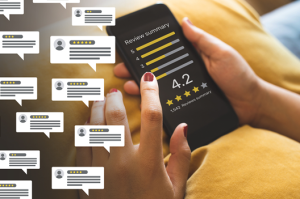


You’ve been there. You need a reliable plumber, a trustworthy daycare, or a restaurant worth celebrating at — and you open up a review site, only to feel more confused than when you started.
Five stars here, two stars there, a suspicious cluster of glowing reviews that all sound like they were written by the same person. You scroll, you second-guess, and eventually you make a choice you’re not entirely confident about.
That experience is not just frustrating. It’s a symptom of a real and growing problem with how we find and evaluate local businesses online. According to BrightLocal’s 2025 Local Consumer Review Survey, consumer trust in online reviews compared to personal recommendations has dropped significantly — from 79% in 2020 to just 42% in 2025.
That means the majority of people now trust a friend’s or neighbor’s recommendation far more than a stranger’s anonymous online review. That is not a small shift. That is a fundamental change in how communities want to find and share information about the businesses they rely on.
Trusti was built for exactly this moment. It’s a platform designed around the kind of trust that actually works — the kind rooted in real relationships, shared neighborhoods, and genuine accountability. Understanding why local recommendations are so much more powerful than anonymous reviews helps explain why platforms like Trusti are becoming essential for modern communities.
Direct answer
Because they come with accountability that anonymous reviews cannot replicate. When a neighbor recommends a contractor, you know who said it, that they live in your community, and that they have a real stake in the recommendation being good.
Source: Nielsen — Global Trust in Advertising (92% of consumers trust recommendations from friends and family above all other forms of advertising).
Think about what an anonymous online review actually is. Someone — you don’t know who, you can’t verify their identity, and you have no idea whether their experience resembles anything close to yours — leaves a star rating and a paragraph of text. That text might be completely genuine, or it might be a competitor leaving a fake one-star review. It might be a loyal customer incentivized with a discount to leave five stars. It might be someone who had one bad day and decided to take it out on a local business owner.
The problem is you have no way to know the difference. When you read a review from an anonymous account named “LocalFoodie42,” you’re making a leap of faith with no context to support it. You don’t know where that person lives, what they value, whether they have high standards or impossibly low ones, or whether they even visited the business at all.
This is what makes trusted local recommendations so different. When your neighbor tells you about a contractor who did excellent work on their roof, you’re not just getting information — you’re getting verified, contextual, accountable information. You know who said it. You know they live in your community, faced the same weather your roof faces, and have a real stake in the recommendation being good. If it goes wrong, they’ll hear about it. That accountability changes everything.
There’s something uniquely powerful about recommendations that come from people who share your streets, your schools, and your daily routines. When your coworker recommends a pediatric dentist, they’re not writing into the void. They’re staking a small piece of their social reputation on that suggestion. If you take their advice and the experience is terrible, you’ll tell them. That real-world consequence is a quality control mechanism that no online review platform can manufacture.
This is the core of what Trusti calls the Proximity Pillar — one of the seven foundational pillars in its TRUST Framework. The idea is straightforward: trust is strongest when it’s local and tangible. The closer the relationship between the person making the recommendation and the person receiving it, the more weight that recommendation carries. Your next-door neighbor isn’t just someone who happened to try a local restaurant; they’re someone who understands your neighborhood, your standards, and the specific context of your life.
When Trusti connects you with recommendations from your actual neighbors, club members, or coworkers, every suggestion comes embedded with that context. You’re not sorting through strangers’ opinions. You’re hearing from people whose recommendations are, in a very real sense, backed by their relationship with you. That’s a fundamentally different kind of information.
Consider how you actually make decisions in everyday life. When you’re choosing a daycare for your child, would you rather read fifty anonymous online reviews or hear directly from three parents in your neighborhood whose children attend that school? The answer is obvious, and it’s not close.
The parents in your neighborhood understand your priorities because they likely share them. They know what the morning drop-off routine is really like. They can tell you whether the center handles sick-day pickups gracefully or whether the director is impossible to reach. That kind of granular, experience-based knowledge doesn’t make it into a star rating.
The same principle applies to finding a restaurant for an anniversary dinner, choosing a mechanic, or hiring someone to renovate your kitchen. When you know who’s making the recommendation, you can calibrate it instantly. You know whether that person is picky or easygoing, whether they have kids who might have influenced the choice, whether their taste tends to align with yours. You can ask follow-up questions. You can call them after and close the loop. None of that is possible with an anonymous online review.
Trusti’s platform makes this kind of connected, contextual recommendation the norm rather than the exception. By organizing recommendations through clubs, coworker networks, and neighborhood communities, Trusti ensures that the people sharing information with you are people you actually know — or people who are meaningfully connected to your life. Your trusted micro-community becomes a curated, living resource that grows more valuable over time.
Decision paralysis is a real and underappreciated drain on daily life. When you’re faced with hundreds of options and no reliable way to filter them, the cognitive load becomes exhausting. You spend time reading through reviews, triangulating between platforms, comparing star ratings, and still end up unsure.
For routine decisions like where to order lunch, this is a minor annoyance. For higher-stakes choices — a plumber when your basement is flooding, a doctor when your child is sick, a contractor when your home needs urgent repairs — it can be genuinely stressful.
Local recommendations cut through this paralysis in a way that anonymous reviews simply cannot. When someone you trust hands you a name and says, “Use this person, I’ve used them twice and they’re reliable,” the decision is essentially made. You don’t need to read forty more reviews. You don’t need to cross-reference platforms. You have what you need: a trusted source with firsthand experience and a real relationship with you.
Trusti’s four-click review process is designed with exactly this dynamic in mind. It’s quick enough that people actually complete it, which means the recommendations stay current, relevant, and abundant. When your community is actively sharing recommendations in a frictionless way, the pool of trusted local knowledge grows continuously — and your ability to find what you need without hours of research grows with it.
Here’s something most people don’t think about consciously but experience every day: local businesses that operate within tight-knit communities behave differently than businesses that rely primarily on anonymous online visibility. When a plumber knows that a bad job will be talked about at the school pickup line, at the neighborhood association meeting, or in the local community group, they have a very direct incentive to do good work. The community is watching, and the community has a long memory.
This natural quality control is one of the most underappreciated benefits of building your local service network through genuine community connections. The businesses that get recommended on Trusti are the ones that have earned their reputations in the real world, not just on a review platform where a slick marketing budget can paper over genuine complaints.
When you find a business through Trusti, you’re tapping into this accountability ecosystem. The business being recommended has a track record with real people in your area. Those people are still around. They can be asked, and the business knows it. That’s a fundamentally different dynamic than hoping a collection of anonymous reviews reflects reality.
Review platforms work hard to surface the “best” results for you, but their algorithms are making educated guesses at best. They don’t know that you have three young children and need a family-friendly restaurant, not a trendy date-night spot. They don’t know that you’re renting and need a landlord-friendly contractor who doesn’t require permits for minor work. They don’t know that you’ve had a bad experience with a particular style of business and want something different.
Your community does know these things. Or at least, it knows enough of them to give you recommendations that are far better calibrated to your actual life. When your neighbor who also has young kids recommends a pediatrician, that recommendation carries implicit information about what it’s like to bring kids there, how the staff handles the waiting room, and whether the doctor is patient with anxious parents. No algorithm can replicate that.
Trusti is built on the belief that real trust comes from real people. The platform creates structured spaces for communities to share what they know — not in the form of star ratings that strip away all context, but in the form of genuine, relationship-backed recommendations that carry the weight of actual human experience.
There’s a distinction worth drawing clearly here: online review platforms give you information. Trusti gives you trust. Those are not the same thing, and the difference matters enormously.
Information can be manipulated. It can be manufactured, incentivized, gamed, or simply misrepresented. Trust is built over time, through repeated interactions, shared experiences, and real accountability. When you trust the source of a recommendation, you’re not just receiving data — you’re receiving a social endorsement from someone whose judgment you have reason to believe in. That is a qualitatively different kind of guidance.
The rise of platforms like Trusti reflects a growing recognition that communities don’t actually want more information. They want better information from people they know. They want the kind of recommendations that used to happen organically over the back fence or at the neighborhood barbecue — but organized in a way that’s accessible, searchable, and reliably current.
A local recommendation comes from someone you know, which means you can verify who they are, understand their perspective, and ask follow-up questions. Anonymous online reviews lack this accountability — you can’t confirm that the reviewer actually visited the business, has similar standards to yours, or is even a real person. The relationship between the recommender and the recipient is what gives a local recommendation its credibility and value.
Trusti organizes recommendations through real community connections — your neighbors, coworkers, and club members. Its four-click review process makes leaving a recommendation fast and easy, which means the platform stays rich with current, relevant information. Instead of sorting through anonymous reviews on a general platform, you’re tapping directly into the knowledge of people who are meaningfully connected to your daily life.
Yes. Trusti is designed for exactly the kinds of decisions that matter most in everyday life. Whether you need a reliable contractor, a family-friendly restaurant, a trustworthy daycare, or a great local doctor, Trusti surfaces recommendations from people in your community who have firsthand experience with those businesses and a real stake in the quality of what they recommend.
Proximity is one of the seven pillars in Trusti’s TRUST Framework. It reflects the idea that trust is strongest when it’s rooted in shared geography and shared experience — when the person recommending a business knows your neighborhood, understands your context, and lives with the consequences of their recommendation. Proximity creates accountability, and accountability creates quality. When you find a business through a proximity-based recommendation, you’re benefiting from that entire chain of real-world validation.
Most review platforms aggregate anonymous opinions from the general public. Trusti is fundamentally different because it’s built around real relationships and real communities. Your recommendations come from people you know — neighbors, coworkers, club members — rather than strangers with no accountability. That shift from anonymous to accountable changes the entire quality and reliability of the information you receive, and it reflects how people actually make their best decisions: by asking someone they trust.
Your community already knows where the best plumber is. It knows which restaurant is actually worth the wait and which daycare director will give you peace of mind on the first day. That knowledge exists — it’s just scattered across conversations, text threads, and word-of-mouth exchanges that are hard to access when you actually need them.
Trusti brings all of that knowledge into one place, organized by the communities you’re already part of. When you join, you’re not just gaining access to a directory of businesses. You’re joining a living network of neighbors, coworkers, and community members who are all working toward the same thing: knowing they can trust where they spend their time and money.
Joining is easy, the review process takes four clicks, and every recommendation you share makes your community stronger. When you help your neighbors find a contractor they can count on, you’re doing something real — and when you need a recommendation yourself, the community you’ve helped will be there for you.
Real trust comes from real people. Join Trusti today and discover what your community already knows.
Read related Trusti stories, tips, and insights to help you make better community-based decisions.

Get the latest strategies, tips, and expert advice delivered directly to your inbox.
By signing up, you agree to our Terms and Conditions.
Join your community and help make the world a more trusted place—one review at a time.

Trusti Chief Marketing Officer
Bill Merrow is the Chief Marketing Officer at Trusti, where he writes about how local businesses grow through trusted community recommendations instead of anonymous reviews and paid ads.
A fractional CMO for more than 100 firms worldwide, Bill has led marketing and sales transformations at Cigna Healthcare, American Express, and General Electric — including building a 40,000+ person sales force and an annuity launch that drove $500 million in sales in 18 months.
His work centers on community-led growth, answer engine and SEO visibility, direct-response copywriting, and the referral, recognition, and lifecycle systems that turn happy customers into a business’s most effective sales force.
Bill believes the shortest path to a new customer is still a neighbor’s recommendation — and that marketing’s job is to make that endorsement easier to earn, easier to share, and impossible to ignore.


© 2026 Trusti | All rights reserved